
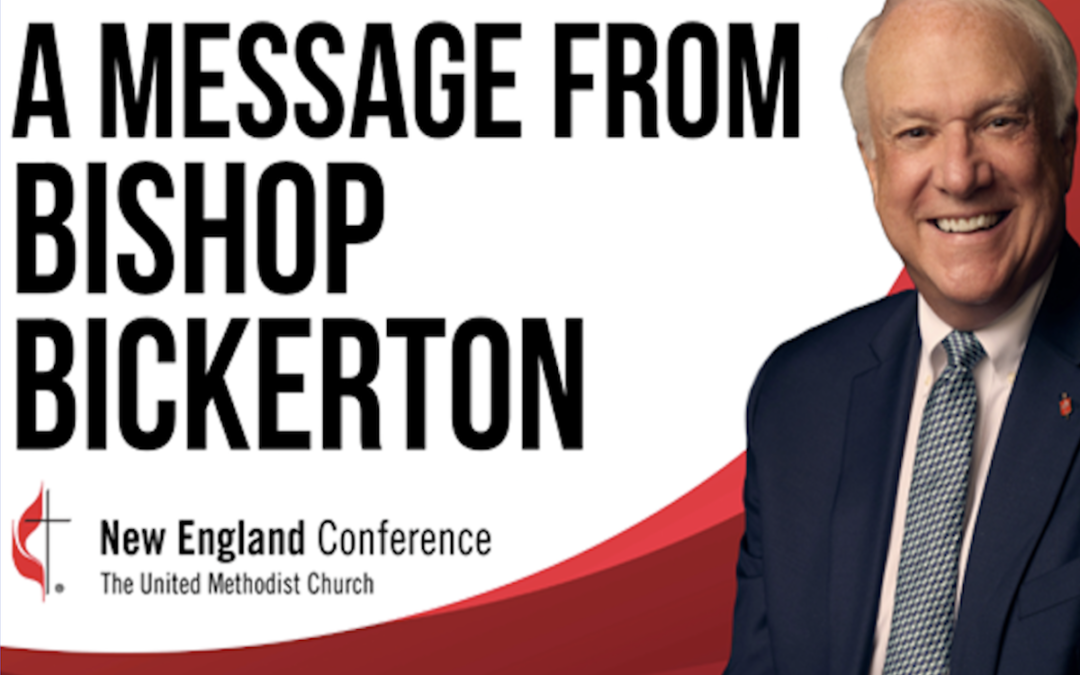
The following letter was recently shared by Bishop Thomas Bickerton on the New England Conference website and via email to subscribers. In it, he reflects on the painful places we find ourselves in at the start of this new year. He also shares a letter written by Bishop Lanette Plambeck, Resident Bishop of the Dakota-Minnesota Episcopal Area of the United Methodist Church, who encourages her congregations and all of us to make “our congregations to be places of refuge and prayer in the days ahead. Be attentive to grief. Listen deeply to those who are afraid. Stay rooted in Christ, who chose the way of self-giving love over the way of force.”
You can read the enirety of the Bishop(s) email(s) below, or on the neumc.orgwebsite, HERE.
From Bishop Bickerton, January 11, 2026
Each time we enter these early days of a new year, we find ourselves making new resolutions. We long for a fresh start, a new beginning, a course correction, and a movement of some kind that will signal that there is something different, something better about the journey before us than the road behind.
In the early days of this new year, we find ourselves facing, with dread in our hearts, even more of the same.
Events in Venezuela have only furthered the division in our country. Some believe it was a necessary action. Others believe it was an inappropriate exercise of power. But it doesn’t end there. With every passing day, plans are outlined for further occupations and actions that can only serve to increase the gap between the “haves” and the “have nots.” The seemingly irreconcilable differences between political parties and religious positions stoke the fear and anxiety that seem to be our constant companions these days.
And then, a shooting in Minneapolis, Minnesota, in which a young mother is killed by ICE. The videos have jump started what we have come to know as the norm: debates around who is at fault, questions surrounding the rights of citizens, government, accusations and name-calling. That debate, fueled by media of all kinds, leaves us reeling.
In our Council of Bishops there is an unwritten covenant that the resident bishop of an area should be the one to take the lead in addressing issues that emerge from the region where they are serving. The beauty of our United Methodist connection is that we have outposts where leaders are called upon to weave our theology and our practice into the fabric of that region to make known how Methodism views and addresses situations that arise.
I am blessed to share that work with the Resident Bishop of the Dakotas-Minnesota Area of The United Methodist Church, Bishop Lanette Plambeck. Below you will find the pastoral message Bishop Plambeck has shared with her people, and now, with us. I believe that her words speak to who we are as the people called United Methodist and represent the way each of us can and should respond to what has happened in Minnesota as well what is continually unfolding in the events of our country and world. Bishop Plambeck puts it simply yet profoundly: The work of the Church begins here.
I stand with Bishop Plambeck, not only in her leadership among the people of Minneapolis, but in the manner in which she calls us all to exercise our faith and practice a better, more holy way.
May it be so.
The Journey Continues, . . .

Thomas J. Bickerton
Resident Bishop
The New Hope Episcopal Area, the New England and New York Annual Conferences.
From Bishop Plambeck
A Pastoral Letter to the Dakotas–Minnesota Episcopal Area
“The Lord is close to the brokenhearted; … those whose spirits are overwhelmed.” – Psalm 34.18 NLT, adapt.
“He has told you, O mortal, what is good;
and what does the Lord require of you
but to do justice, and to love kindness,
and to walk humbly with your God?” – Micah 6.8 NRSV
Grace and peace to you in the name of Jesus Christ.
I write as one who, in my episcopal role, is called to guard the faith, shepherd the people, and work for unity. It is from this responsibility that I offer these words.
Today in Minneapolis, during a federal immigration enforcement operation, Renee Nicole Good was fatally shot. Investigations are underway. Accounts differ. Many details remain unclear. At the time of this writing, what we know, and must not move past too quickly, is this: a human life has been lost.
The work of the church begins here. Before we receive deep analysis or a full explanation of the events that led to the shooting, we enter into lament. We grieve a life ended too soon. We hold in prayer the family and loved ones who now carry an unimaginable loss. We acknowledge the fear and trauma this event has stirred, especially among immigrant and refugee neighbors for whom encounters with law enforcement already carry profound risk.
We also speak to the wider moment in which this tragedy occurred. Across our nation, we are witnessing a troubling willingness to normalize violence as a tool of order and to resist accountability as though it were a threat rather than a safeguard. The church must say clearly: power that is unexamined, unchecked, or unaccountable stands in tension with the way of Jesus Christ.
Scripture reminds us that authority is given for the sake of the common good. When power is exercised, its first obligation is to preserve life and protect the vulnerable.
The measure of justice is not how quickly actions are justified, but how faithfully truth is sought and responsibility is held. This word is spoken not in condemnation, but in love. Love for communities living in fear. Love for institutions that must be called back to their highest purposes. Love for a nation whose soul is shaped, for better or worse, by the choices it makes in moments like these.
As your bishop, I call our congregations to be places of refuge and prayer in the days ahead. Be attentive to grief. Listen deeply to those who are afraid. Stay rooted in Christ, who chose the way of self-giving love over the way of force.
In moments of grief and uncertainty, most of us naturally lean toward news voices we already trust. In our vulnerability, we rush to make complex situations clear-cut. While that is human, it can also narrow our understanding. I encourage us to broaden our listening, seek out careful reporting from news sources representing multiple perspectives, and remain open to voices that may challenge our assumptions. Expanding how we listen is one way we practice humility and love in the pursuit of truth.
In this fragile space between tragedy and truth, may we be a people who lament honestly, seek justice humbly, and refuse the lie that violence has the final word. We hold fast to the resurrection promise that love endures and that life, not death, will have the final say.
May the God who binds up the brokenhearted draw near to all who mourn, and may the Spirit lead us in the way of justice, mercy, and peace.
Grace and peace,

Bishop Lanette Plambeck
Resident Bishop
Dakotas-Minnesota Episcopal Area of The United Methodist Church
Prayer
God of mercy and nearness,
we come to you with heavy hearts.
We grieve a life lost and hold close all who mourn.
Be near to those whose hearts are broken,
to those who are afraid,
and to all who are waiting for truth to come into the light.
In this tender space between tragedy and understanding,
teach us to lament honestly,
to seek justice with humility,
and to walk gently with one another.
Guard us from haste, from hardened hearts,
and from the temptation to let fear or violence shape our way.
We place our hope in you, O God of resurrection.
When death and grief seem to have the final word,
remind us that life and love endure.
Make us instruments of your peace,
and keep us faithful in the days ahead.
We offer this prayer in the name of Jesus,
who brings life out of death
and hope out of sorrow.
Amen.